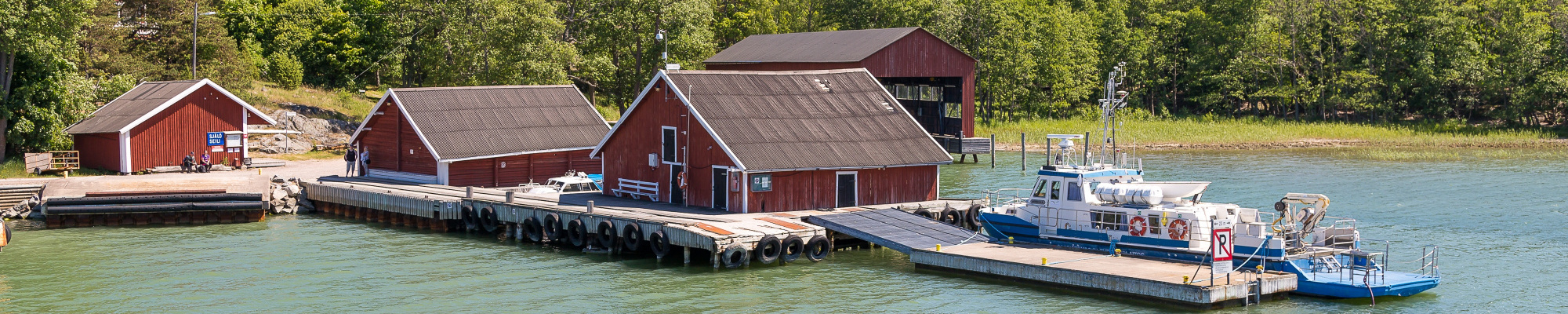
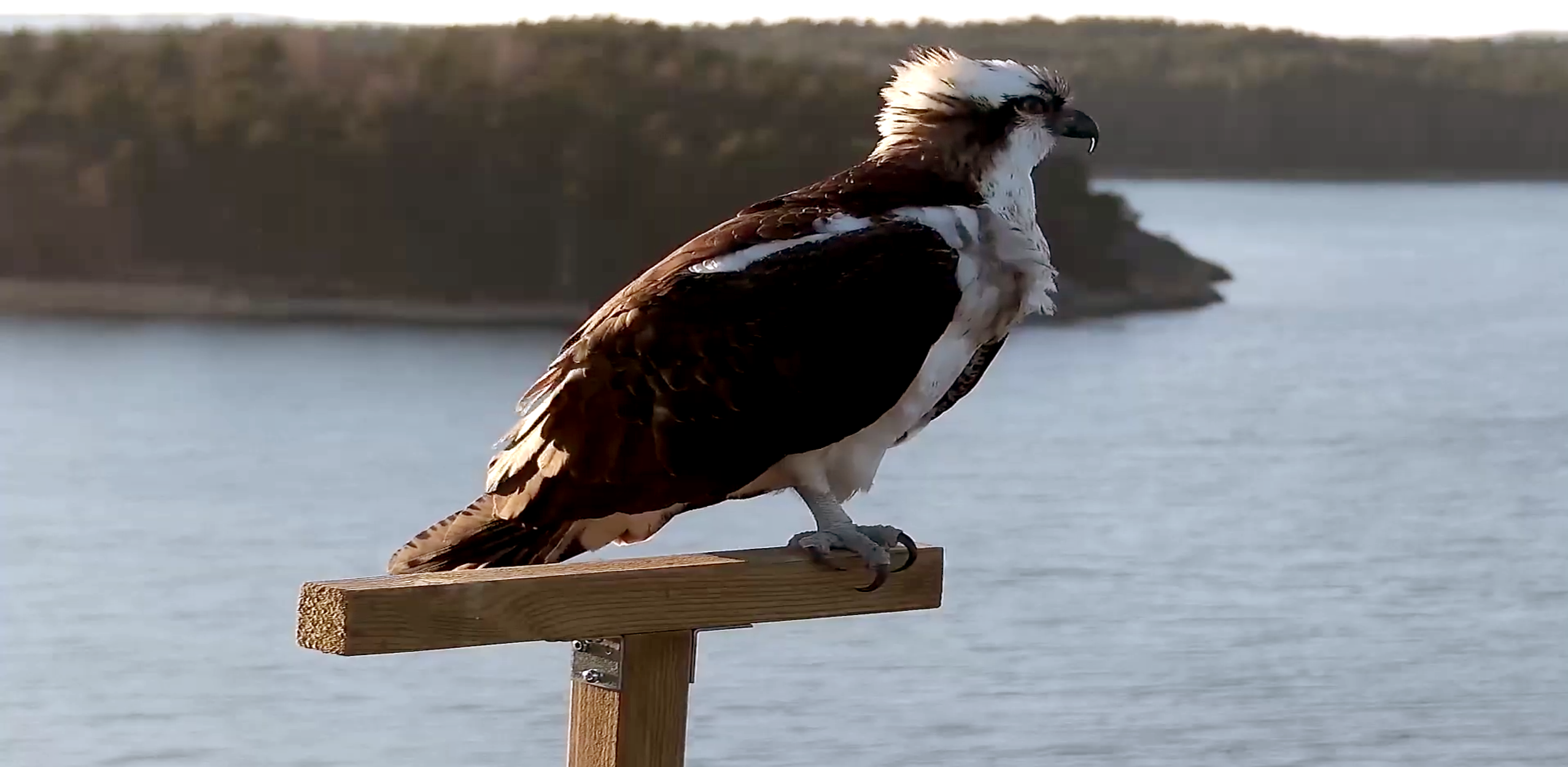
The osprey camera, maintained by the University of Turku and Turku University of Applied Sciences, is located on the island of Seili on top of an approximately 35-metre-high illuminated leading light. The camera’s real-time 1080p stream can be followed all year round. The camera operates around the clock, and infrared light that does not disturb the birds makes it possible to follow events at the nest in the dark as well.
The osprey camera offers a window into the heart of the Archipelago Sea. From April to September, you can follow the ospreys’ nesting through the camera, and in winter the camera lets you follow the archipelago’s changing weather and occasional visits to the nest by other bird species such as white-tailed eagles, crows and ravens. The osprey camera can also be used in teaching and research. By following the osprey nest, school groups can, for example, easily explore themes related to the life cycle and behaviour of birds and biodiversity. Camera monitoring also provides information that can be used in research.
The osprey nest is monitored with a surveillance camera installed in 2018 (Milesight Pro PTZ Dome 5 MP). The camera feed is transmitted via NanoBeam antennas located on the range board and on the main building to the server of the Archipelago Research Institute, and from there on to YouTube and to this website. The nest filming has been granted an exemption under the Nature Conservation Act from the protection provisions concerning the osprey (VARELY/8791/2024).
YouTube stores several hours of video history, which you can scroll back through if you wish. Clicking the “Live” text takes you back to the real-time stream. You can change the video quality by clicking “Settings” in the video player and selecting the quality you want. The live stream works best in the Firefox browser and in the YouTube app on mobile devices.
Because the camera is located on an island, the live stream may occasionally be interrupted by power cuts or other connection problems. Connection problems affecting the live stream are fixed only on weekdays and as soon as possible. Technical faults that cannot be fixed remotely are naturally repaired only in winter or during ringing in July.
Licence and citation guidelines: The material on the Saaristomeri.utu.fi website is licensed under Creative Commons Attribution 4.0. Data covered by the licence may be used freely provided that the source of the data is credited: “Seili Environmental monitoring programme, Osprey web camera. YEAR. Turku University/Turku University of Applied Sciences, Turku. https://saaristomeri.utu.fi/seili-osprey-web-camera/“.
We encourage the sharing of videos and images from the nest on social media using the hashtags #seiliospreys, #uniturku, and #turunamk.
History of the Nest:
The nesting of ospreys (Pandion haliaetus), members of the hawk family (Accipitridae), has been followed on Seili via a nest camera since 2006. The camera was set up on Seili as a collaboration between Turku University of Applied Sciences and the Archipelago Research Institute, as part of the NatureIT project coordinated by Turku University of Applied Sciences, and later by the Saaristomeri.info and BalticSeaNow projects. Since 2015, the Archipelago Research Institute has been responsible for providing the video connection, and the birds’ nesting has been viewable both on YouTube and on this website.
| Year | Nesting osprey couple | First sighting | First egg laid | 1. chick hatched | 2. chick hatched | 3. chick hatched | Incubation period (days) of the 1. chick | More information |
|---|---|---|---|---|---|---|---|---|
| 2025 | ||||||||
| 2024 | In 2024 there was a new pair at the nest. The male has a yellow colour ring with the code TFS on its left leg and an aluminium ring on its right leg. The female is unringed. The male and female arrived at the nest in April. Before nesting began, they were sometimes away for days at a time, and other ospreys also visited the nest. The female laid three eggs, two of which were taken by a crow, and one hatched into a chick. Later, a crow also took the chick while the parents were away from the nest. The male and female often left the nest unguarded for several minutes at a time, many times a day. The pair spent time at the nest throughout the summer, and other ospreys visited the nest during the summer as well. The female left on migration in mid-August and the male in September. Gulls and crows visited the nest regularly, and a white-tailed eagle and an owl also appeared a few times. | |||||||
| 2023 | In 2023 there was no nesting and no chicks. The male (ringed, right leg) and female (yellow ring, PKJ/Timo Pylvänäinen, ringed as a nestling in Joutsa in 2018) that had attempted to nest at the Seili nest in previous years arrived in April. Other ospreys also visited the nest regularly. The nest was hardly improved, and the female of the old pair eventually left the nest for good. A new female (ringed, left leg) stayed at the nest all summer, and the male repaired the nest with her. The ospreys left on migration in August, after which other ospreys still visited the nest, including the female that had left earlier. Crows visited the nest regularly throughout the season. | |||||||
| 2022 | In 2022 the nesting attempt failed and no chicks hatched. The first osprey (unringed) was seen at the nest on 9 April. The male (ringed, right leg) arrived at the nest on 10 April and the female (yellow ring, PKJ/Timo Pylvänäinen, ringed as a nestling in Joutsa in 2018) on 19 April. The female laid three eggs: on 30 April, 4 May and 8 May. A crow ate one egg on 11 May, and when the camera feed returned after a longer break on 18 May, only one egg remained in the nest. The last egg broke while the parent was incubating it on 30 May, and the parent ate its contents. It was possibly an infertile egg that had already been leaking for several days. The ospreys spent more time at the nest and defended it more effectively than in previous years, and the male brought the female more fish. At times the ospreys left together to feed, leaving the nest unguarded. Crows and a white-tailed eagle disturbed the nesting. The pair and a third osprey were still seen at the nest on 25 August. The date of their departure on migration is not known. | |||||||
| 2021 | Hilma & Onni | 7.4 | 1. 14.5. 2. 18.5. (re egg-laying) | 1. Egg robbed by crow 15.5.21 2.Egg robbed again by crow 2.6. | In 2021 the nesting attempt failed. The female (yellow ring, PKJ/Timo Pylvänäinen, ringed as a nestling in Joutsa in 2018) arrived at the nest first on 7 April, and the male (ringed, right leg) arrived on 12 April. During April, an unringed male and another ringed male (left leg) also visited the nest. The pair made few mating attempts and did little to improve the nest. The ospreys brought bream to the nest but otherwise did not spend long periods there. The female laid the first egg on 14 May. The next day both ospreys left to feed, and a crow ate the egg. A new egg appeared in the nest on 18 May, but on 2 June the same thing happened: both ospreys left the nest, and a crow ate the egg. The nesting pair is young and inexperienced, which explains the failed breeding. The camera mount was reinforced on 15 June, and a new microphone was installed at the same time, but the replacement did not improve the sound quality. Due to connection problems, there is no information on events at the nest after June. | |||
| 2020 | Olof & Malin | 5.4. | 22.4 | 3 eggs at the nest. Male not sighted after 11.5. 14.5. female left the nest empty most likely because the male had not provided the incubating female with food. Crow ate the eggs ca. 16:08 o'clock. Since then, several ospreys sighted at and nearby the nest. |
||||
| 2019 | Olof (M) & Malin (F) | 4.4. | 24.4. | 1.6 | - | - | 38 | The camera's position was changed 26.3 and a sitting perch was also installed.The microphone is at the moment turned off due to technical issues. 3 eggs were laid, but only one hatched. The chick was named Kari. |
| 2018 | * Several individuals sited | 9.4. | Several ospreys sited at the nest but no nesting. New nest camera installed on December 11 2018. |
|||||
| 2017 | Vasuri (M) & Tilda (F) | 3.4. | 16.4. | 25.5. | 27.5. | 27.5. | 39 | Tilda disappeared 27.6 and one of the chicks died 13.7 seemingly due to sibling rivalry. |
| 2016 | Vasuri & Tilda | 2.4. | 21.4. | 28.5. | 31.5. | 37 | Live audio is included | |
| 2015 | Vasuri & Tilda | 10.4. | 21.4. | 31.5. | 31.5. | 40 | The University of Turku starts to maintain the camera | |
| 2014 | Vasuri & Tilda | 10.4. | 23.4. | 1.6. | 2.6. | 3.6. | 39 | |
| 2013 | Vasuri & Tilda | 11.4. | 28.4. | 6.6. | 6.6. | 8.8. | 39 | |
| 2012 | Vasuri & Tilda | 10.4. | 3.5. | 4.6. | 4.6. | 6.6. | 32 | BalticSeaNow-project starts to maintain the camera. New camera and a nesting platform is added. |
| 2011 | Vasuri & Tilda | 13.4. | 3.5. | 12.6. | 12.6. | 14.6. | 40 | Several ospreys are observed to visit the nest. Vasuri prevails and mates with a female named Tilda. |
| 2010 | Eeli (M) & Ristipää (F) * | 8.4. | *First egg is laid 28.4 but nesting fails. | Several ospreys are observed at the nest, Soma (F) and Vasuri (M) were named in addition to Eeli and Ristipää, | ||||
| 2009 | - | 5.4. | 30.4. | - | - | - | - | Some information lost due to a thunderstorm |
| 2008 | - | - | - | - | - | - | - | Saaristomeri.info project maintains the camera. |
| 2007 | - | - | - | - | - | - | - | |
| 2006 | Tapani (M) & Liisa (F) | - | 3.5. | - | - | - | - | TUAS installs the camera as part of Natureit.IT project. The osprey couple lays three eggs, additional information not available. |